3/29/2009
Up until this point I’ve been pretty positive about my writing. This has been a very positive experience for me, in general, but there are a few things that I have been struggling with for the past few weeks. Some of them will be things that become easier over time, but some of them I think I will struggle with for the entire time I am here.
This morning I faced one of those things that I think will get easier, although it is possible that it won’t. I did my laundry. This is only the second time, so I had a LOT of clothes to wash. Some of them were very dirty. I ran into a PCV who has just completed his first year in Azilal last weekend, and was shocked by how dirty he was. But I could easily see how I could tend in the same direction when I live alone and have to do all my own washing. Because it sucks. Really, really sucks!
Here is how it goes:
Build a fire in your largest brazier with found wood. Fill a metal bucket with water and heat.
Go on a hunt for all your wash buckets. You may have a hard time finding them. One is in the field where you left it after your last wash. Another bucket is in the bitlma, where you used it to bathe last night. Another is in the sheep pen and will need a good scrubbing before it is fit for usage again.
Mix Tide (the generic term for detergent) with a little water.
Put heated water into your largest washtub with a little tide and all your white clothing.
Get over the embarrassment of having more clothes that your family owns combined. They don’t really care.
Wash each item individually, adding tide liberally as needed. Various washing motions are used. If the item has no spots, swish in soapy water and knead like you would bread. For spots, add tide directly to spot and scrub between your knuckles. This will surely be painful, as you are grinding concentrated tide into your nail beds, but at least your clothing will be clean.
Attempt to clean all your own underwear, so as to avoid the embarrassment of having your host mother do it. She will notice that you are doing this, but think that you are failing miserably at getting anything clean, so she will probably end up washing it anyway. Attempt to explain in Tamazight that some of it is very old and some of the stains will not come out, no matter how much tide you use. Save the rest of your embarrassment for when your underwear is hanging on the line where everyone in the village can see it.
Place whites in a bucket with a little bleach and water. Let sit.
Repeat process with colors, washing shirts and pants, first, then undergarments and socks.
Rinse all clothes in second washtub with cold water. Hang to dry on the wash lines outside, even though it is raining hard. Hope to God that you have a clean pair of underwear hidden somewhere in your luggage for tomorrow, as most of this will not be dry in time.
Repeat process with some clothes when the clothesline fails under the weight of your wet clothing. This is a good time for language exchange, as you can teach your host mother some English. Words like “crap” and the phrase “oh f**k” come in handy in times like these.
Prepare tea and drink it sitting next to the coals left in the brazier. Laugh with your host mother about everything.
And that is how you wash your laundry. I think I may end up paying someone to do it for me when I get to my site….
Useful Vocabulary:
Tide: the generic term for detergent. Sometimes it is actually Tide brand. More often, it is Omo, which smells worse and is more abrasive, but cheaper. It is pronounced, “teed.”
Ish: oops.
Sbbn: the verb used to mean “washing of clothing.”
Aman: water
Saturday, April 18, 2009

Thursday, March 26, 2009
Hey there.
I have a lot to write and a lot to talk about, but almost always never get time to be on the internet! Lately I've been writing a lot at night, with the intention of posting them on the blog when internet happens. Today I am in our "Hub" site, where we train with the other groups of Tamazight speakers. My computer is working fine, and the cyber's internet is decently quick! So here we go!
Culture Shock
3/11/2009
I have been two days at my CBT site now. It is probably one of the most beautiful places that I have ever been. My douar is spread out over about a kilometer but the side of a massive lake. The lake is formed by a dam that gives Morocco 25% of it’s electricity. With the mountains, frogs, and the gentle rain we had our first night, I feel like I’m in Newhalem again!
As I mentioned before, Morocco has experienced an unusually large amount of rain this winter. Springtime in my douar is absolutely lovely. There are a lot of flowers blooming everywhere. Poppies, wild lavender, some sort of calendula, and vetch are the few I have been able to identify. There are also a lot of wild herbs- spicy Atlas oregano, dill, and mint (of course!) I have been battling a cold and some other ailments, as can be expected of someone living in a new country, but I still made sure that I got out on a walk today. My host sister, who is six, and I walked down the creek and soaked our feet for a while. The red stone dyed the bottoms of my feet and my sister kept saying it was like henna for l’3aid.
Speaking of it, today was my first Moroccan 3aid. We celebrated the birth of the prophet Muhammad with a big breakfast of some sort of puffy pancakes and olive oil (yummy!) We also had couscous for the first time at dinner tonight, which was a surprise because dinner is usually pretty simple- just rice cooked in buttermilk, with the herbed oil on top (also yummy!) Because I have not been feeling well, I haven’t been eating much, which I think has them concerned. And yet, I go to bed completely stuffed full every night. I worry about gaining a lot of weight here, but then I remember that to get to l-madrassa I have to walk 20 minutes up and down a lot of hills, and it seems like everyone’s favorite thing to do here is just to walk around and chat.
Okay, about culture shock. For the first five days of training, we were staying in an absolutely zweena (cool) hotel. I complained about a few things, namely the high walls with broken glass on the tops, the gendarmes who waiting outside and called each other on their radios whenever a group of us left, and the fact that for some reason everyone wanted to go out in huge groups of up to 20 people. Other than that, it was great. WiFi in the reception, hot water between 7pm and 7am, manicured grounds, and frequent tea breaks. The streets of our town were wide and clean. Much of the town had a new feeling to it, even in the medina (old city.) A lot of the people spoke French and sometimes even English.
My room here at CBT is long and narrow, with two windows and a small cot. I have a coat rack for my clothes and no other furniture. My family seems to be one of the less well off families in the community, although my father has a zweena motorbike and everyone has a cell phone. They have their basic needs met and the salon is pretty comfortable, with a TV and DVD player. Yesterday, when I observed all these things, I totally freaked out and nearly quit the Peace Corps then and there. Especially when I realized that sleeping on the rocky ground outside would be more comfortable then this cot.
Today we ate some Theo chocolate from Seattle in lieu of tea during class, and I got to thinking about how different my life is now from what it was even just three weeks ago- shopping at whole foods, having easy access to everything I need, wearing whatever I want, and sleeping on a super comfy futon in my own huge room, in a house where everyone speaks the same language! It would have been easy to stay there. Even if I had made some sort of big change, like going back to school or moving out of Seattle, it would have still been the easy route. Part of me already misses the comforts of home. However, the more I learn and the more people I meet, the more confident I am that this is the right place to be.
My host mother and host sister are wonderful about helping me with my Tamazight. We laugh a lot. The food is wonderful. Just stepping outside in the morning to see the creek, the lake, and the groves of almond trees around my house lifts my heart up to the sky. And if that wasn’t enough, every time I tell someone that I am learning Tamazight, imiq simiq, they are so happy!! Tamiricanit! Tamazight! Muzien!! Tbarkallah!
I’m pretty sure Tamazight is one of the hardest languages in the world, but I’m so glad that I’m learning it and I feel blessed to be here.
Walking to Lmadrassa
3/17/2009
Every morning my host mother and I get up at about the same time. She rolls out of bed and heads to the kitchen to put on the kettle. I roll out of bed and get dressed, brush my hair, and get my books ready for the day. Then we have tea and bread with butter (zbd) or oil (zit.) Usually for breakfast, it’s just my host mother and I. Her husband goes before I get up, and her daughter gets to sleep in a little.
After breakfast, I quickly brush my teeth and make sure I have everything, then head off to school.
The dog, Cobees, follows me to the bridge. Here I meet the first of the children going to the school. For the past two mornings, it has been Ali, the son of our LCF’s landlord. He is a handsome boy of about ten. We exchange cheerful greetings in passing. But he is the ONLY child I pass who feels comfortable enough just shouting a greeting to me. From here on out, every child I greet offers me a hand to shake, if they are a boy, or they reach up to grab my shoulders and turn their cheeks up to be kissed if they are a girl. There are 84 families in this village. Most of them have several children. I wager I shake the hands or kiss around 25 children a day, counting my host sister. Some of them I meet coming back from madrassa and we go through the whole greeting again.
Salaam. May t3nit? Labas? Kulshi bixir!! Mzzien! L3awn!
Again and again and again.
I really like this greeting ritual.
At least until I get sick again.
Update:
Things are going really well! I am no longer sick, lHamdullah! I spoke with the country director briefly last Thursday and was told that if I could make it through week one of CBT with a bad cold (fever, chills, body aches), then I would be fine for the next two years. It was pretty rough, but now I feel GREAT!
The language is still difficult, but I am pulling through. I can make my needs known with a combination of Tam and frantic gesturing. Instead of saying “ur sing” or “ur fmhg” all the time, I now say “nk sing imiq!” Any usually the other person says, “imiq simiq!” Today I even joined in the dinner table conversation a bit.
It’s sort of strange only being able to say disjointed, uncomfortable sentences in a language. I know how to say “peel an egg” in Tam, but not “What do you do for work?” Mostly I just stay quiet instead of saying anything. The other day my host mother’s sister, who is the kindergarten teacher here in town, came for lunch. She was here on my first day, pointing out words in Tam and using a bit of French to help me understand. This time around we played the vocab game again and I did pretty well, but I’m still unable to really converse. She was criticizing me for this to my host mother, and my host mother told her to shut up, because I can understand most of what they are saying (which is true) and because I’d only been here for a week and learning a new language takes time! Did I mention that I love my host mother? I really do.
Today my friend and I were talking about saying goodbye to our families, and when I told my host mom that it made me sad to say goodbye to my family for such a long time, she was very understanding. I think she was a bit relieved, too. It is an incredibly strange thing for a young, unmarried woman to leave her family to travel and work like I am. I think she likes knowing that I think about my family at home a lot and that I have a sense of duty. Now, if only my language skills could catch up so I could tell her how proud they are of me!
I also got to go on my first hike in Morocco! Our LCF is from nearby and has spent a long time in the mountains working as a teacher. He loves hiking and being up in the mountains, and I could tell that he has been itching to get out of the main part of town and get up into the hills. So on Sunday three of us joined him and headed up the creek. We thought we might try to find the spring that is the source of our water here in town, but it became so much more. We found the spring, but by then we didn’t care. We were having too much fun!
There is a very pretty narrow canyon with lots of little pools. One of the boys had been running and was still wearing his shorts so he jumped in. The rest of us splashed around. Then we climbed up a bit more, until we spotted the ruins of some old houses above us, so up we went. We ate green almonds (sour!) and looked at the plant life. There is a cactus that grows everywhere here which apparently sprays when it is broken and the sap causes blindness. Eek! Oh, we also found a lot of carob trees! They were way over ripe, but I chewed on the bean pods anyway. They were rough and crunchy, but very tasty! It was kind of like chocolate with a lot of vanilla mixed in. The tree itself is very pretty, with knarly bark and really pretty waxy leaves. We have a whole day free from classes tomorrow, and I am hoping to fill some of it with a hike up the hill to explore the beautiful castle up there!
Cooking With My Host Mother: Tajine win Maria
3/23/2009
Meat, enough for every person who will be eating. I’ve had this dish with beef both times, but I think it would be wonderful with chicken. Or you can skip it and add chickpeas or something like that.
Olive oil
2 onions (we use red, but I don’t think it matters), diced
1 tomato, diced
1 clove garlic, diced
1/2c. diced cilantro
About 1 tsp each:
Cinnamon
Ground ginger
Paprika
Pepper
Saffron (here we use a cheap imitation powder… if you choose to use real, use only a few threads)
1.5 tsp salt
4-5 prunes
1 cinnamon stick
1 tbsp sugar
2-3 eggs, hard boiled (optional)
Soft bread
Cover the bottom of a pressure cooker in enough oil to coat. Add meat and spices. Stir until meat is covered in spices, then add diced onion, tomato, garlic, and cilantro. Let simmer over med-high heat about five minutes. While this is simmering, put prunes in a sauce pan and just barely cover in water. Add cinnamon stick and sugar, then simmer. Add 2 cups water to the meat/veggie mixture, cover and tighten the lid of the pressure cooker. Simmer 30-45 minutes, until onions and tomatoes have cooked down into a thick sauce. Add prunes and their water, then simmer an additional 20 minutes. Turn the entire dish out onto a single plate and place sliced eggs on top.
Eat using soft bread (or couscous or rice, if you choose).
Table Manners
Almost everything we eat here is served with bread. Most of the women here make bread every day. Bread is usually also the only utensil on the table. Your host will break the bread and pass everyone a large chunk. Say “bismillaH” (to your health) and then break a small piece of bread off and dig into the communal dish in front of you.
You should only eat from the area that is closest to you. Under no circumstances should you reach across the tajine to grab a tasty morsel. Use your thumb and first two fingers of your right hand only. Use your left hand when breaking bread or tearing meat, but do not use it to put food to your mouth or to reach into the tajine. Do not lick the fingers of your left hand. This is because eating with the left hand is seen as eating with the devil, but also because most people use their left hands to clean themselves after a visit to the bathroom. Even if you are not adventurous enough to try this way of maintaining your personal hygiene, you should always wash your hands with soap before and after your meal.
When most of the vegetables and sauce contained in the tajine have been eaten, your host will separate out the meat to be consumed. Do not touch the meat until your host has done this. When you have your serving of meat, you may tear it into small pieces using both hands, either on a small plate provided, in the tajine, or on the table itself. Eat the meat using bread.
You will have to assert yourself if you are full before all the food in front of you is consumed. Moroccans may be concerned that you are sick if you do not consume the entire thing. However, if you politely maintain your ground, they will leave you alone… at least until dessert is served.
Dessert is usually fruit. Eat only fruit that can be peeled. Avoid the apples- they aren’t very good. Don’t avoid the oranges- they’re the best I’ve ever tasted. Then ask if you can help clean up. Don’t expect that they will let you. You are a guest, after all. If they do, enjoy the quiet time in the kitchen with your host mother, and then go watch Egyptian soap operas that no one understands on the TV.
Also, most families are very forgiving of people who speak with food in their mouths, who belch, or who eat audibly. Please avoid farting at the table. If you must, blame it on the little kid next to you. You can impress your friends by belching and saying “LHamdullah” all at the same time. Juuuuust kidding.
Useful words:
- ts: eat! Pronounced: t-s-cha
- Su: drink
- Djwng: I am full. Pronounced: da-jee-oo-n-gch (aspirate the last syllable)
- Shbet: I am full.
- Yadfud: good food
- Tabarkallah: well done (literally, God Bless It)
- Safi: all done
- Agroum: bread. Pronounced: ah-rughm.
- Motisha: tomato
- Azalim: onion
- Tajine: the dish you are eating.
- Shukkran or saHa: Thank you
- Bla jmiL: you’re welcome
Best thing EVER: Moroccan Dinner Parties
3/25/2009
Tonight we had dinner at my CBT-mate’s house all together. His mother is a spunky lady of about 60. He also has two host brothers in their early 20s, one host sister, two host sisters in law, one host nephew, and his host father. It’s a full house!
I headed over a bit early to study a bit with my friend, but the only place where it is not hashuma (shameful) for a man and a woman to study together is the salon, where everyone was watching their favorite Egyptian (or Turkish, maybe?) soap opera. So we didn’t get much work done! Then the whole rest of the group trouped in at 8pm and we were served mint tea. Two of the other girls in the group brought their host sisters, so we had a whole crew of girls who are about 10 years old. First we played Tamazight telephone with the whole crew. For those of you who do not remember, or for those who never were 10-year-old girls, telephone is played by passing a whispered phrase from person to person until it comes full circle. The last person then speaks the phrase out loud and it is compared to the original phrase. It’s pretty fun in English, but in Tamazight, with several non-native speakers, it’s ridiculous! At one point we realized that one of the host sisters was changing what we were saying into things that were vaguely Hashuma. We tried something in English, which was fun as well. Then we played cards for a long, long time, until finally tajine was served at about 9:15.
When a dinner party such as this happens, two (or more) tajines are served, in separate spaces. Sometimes it’s the men who are served first, then the woman eat later. In this case, we were served our tajine, which we ate as a group with our LCF and one of the host sisters (this one is 30 and has been a very helpful person to get to know.) Eight people can make pretty short work of a tajine and a couple loaves of flat bread! After that we at shfet, or small, thin pasta with sugar, nuts, and cinnamon. It’s pretty tasty! Then we had oranges and made our escape!
I just quickly want to touch on the ten-year-old girl crew and my feelings about Moroccan children in general. I know I mentioned before that I’d had some harassement from kids on our second day in Morocco. I had been out walking in the city with a friend who speaks excellent French. We passed a group of boys who were about 9 or 10. They cut in between my friend and I, and said “Bonjour, Madame!” My friend answered them, “Bonjour!” Then followed us for a short time, asking for us to buy them cokes, and when we ignored them, one of them pinched my butt and then ran away.
At the time, I laughed it off as just a strange cultural experience, but when we came to our CBT site, I realized that it had affected me more than I thought. On our first visit to our Hub site (where we train with the other Tam-speaking health groups), I was afraid to go out into the town alone, or even at all. This was not because I was afraid of getting lost or afraid of the language barrier, but because I was afraid of the kids. For those of you who know me well, you will understand that this was an incredibly upsetting thing for me. I have always been good at making connections with kids pretty quickly, but that is in America. In America, I have no language barrier, I generally look something like the kids in question, and kids are taught not to stare or harass people on the street. Those are challenges that I have to face here walking through the streets.
Some kids here demand presents. Some kids here surround you. Some kids here make fun of you. Some kids here throw rocks.
But of course, not all of them do. Most of them will be curious about you but not hostile. Most of them will be interested in positive interactions. Most of them will be surprised and happy when you start speaking Tamazight to them.
Here in Ait Halouane, I have a lot of interactions with kids, one of which I explained below. Other than my host sister, I spend the most time with the host siblings of my fellow trainees. It seems like the majority of these girls are about 10 years old. They’re all really pretty and spunky. They all laugh a lot, and cuddle, and play games. They are the BEST Tamazight teachers! Getting to know these girls (and a few boys) has been really helpful for me, because they have helped me remember that kids are not my enemies, and they can be extremely helpful in integrating into the community!
We talked a lot about unwanted attention in our class session today, and one of the things that people say is that you can very easily divert unwanted attention by using humor. I’m working on cultivating that skill!
I have a lot to write and a lot to talk about, but almost always never get time to be on the internet! Lately I've been writing a lot at night, with the intention of posting them on the blog when internet happens. Today I am in our "Hub" site, where we train with the other groups of Tamazight speakers. My computer is working fine, and the cyber's internet is decently quick! So here we go!
Culture Shock
3/11/2009
I have been two days at my CBT site now. It is probably one of the most beautiful places that I have ever been. My douar is spread out over about a kilometer but the side of a massive lake. The lake is formed by a dam that gives Morocco 25% of it’s electricity. With the mountains, frogs, and the gentle rain we had our first night, I feel like I’m in Newhalem again!
As I mentioned before, Morocco has experienced an unusually large amount of rain this winter. Springtime in my douar is absolutely lovely. There are a lot of flowers blooming everywhere. Poppies, wild lavender, some sort of calendula, and vetch are the few I have been able to identify. There are also a lot of wild herbs- spicy Atlas oregano, dill, and mint (of course!) I have been battling a cold and some other ailments, as can be expected of someone living in a new country, but I still made sure that I got out on a walk today. My host sister, who is six, and I walked down the creek and soaked our feet for a while. The red stone dyed the bottoms of my feet and my sister kept saying it was like henna for l’3aid.
Speaking of it, today was my first Moroccan 3aid. We celebrated the birth of the prophet Muhammad with a big breakfast of some sort of puffy pancakes and olive oil (yummy!) We also had couscous for the first time at dinner tonight, which was a surprise because dinner is usually pretty simple- just rice cooked in buttermilk, with the herbed oil on top (also yummy!) Because I have not been feeling well, I haven’t been eating much, which I think has them concerned. And yet, I go to bed completely stuffed full every night. I worry about gaining a lot of weight here, but then I remember that to get to l-madrassa I have to walk 20 minutes up and down a lot of hills, and it seems like everyone’s favorite thing to do here is just to walk around and chat.
Okay, about culture shock. For the first five days of training, we were staying in an absolutely zweena (cool) hotel. I complained about a few things, namely the high walls with broken glass on the tops, the gendarmes who waiting outside and called each other on their radios whenever a group of us left, and the fact that for some reason everyone wanted to go out in huge groups of up to 20 people. Other than that, it was great. WiFi in the reception, hot water between 7pm and 7am, manicured grounds, and frequent tea breaks. The streets of our town were wide and clean. Much of the town had a new feeling to it, even in the medina (old city.) A lot of the people spoke French and sometimes even English.
My room here at CBT is long and narrow, with two windows and a small cot. I have a coat rack for my clothes and no other furniture. My family seems to be one of the less well off families in the community, although my father has a zweena motorbike and everyone has a cell phone. They have their basic needs met and the salon is pretty comfortable, with a TV and DVD player. Yesterday, when I observed all these things, I totally freaked out and nearly quit the Peace Corps then and there. Especially when I realized that sleeping on the rocky ground outside would be more comfortable then this cot.
Today we ate some Theo chocolate from Seattle in lieu of tea during class, and I got to thinking about how different my life is now from what it was even just three weeks ago- shopping at whole foods, having easy access to everything I need, wearing whatever I want, and sleeping on a super comfy futon in my own huge room, in a house where everyone speaks the same language! It would have been easy to stay there. Even if I had made some sort of big change, like going back to school or moving out of Seattle, it would have still been the easy route. Part of me already misses the comforts of home. However, the more I learn and the more people I meet, the more confident I am that this is the right place to be.
My host mother and host sister are wonderful about helping me with my Tamazight. We laugh a lot. The food is wonderful. Just stepping outside in the morning to see the creek, the lake, and the groves of almond trees around my house lifts my heart up to the sky. And if that wasn’t enough, every time I tell someone that I am learning Tamazight, imiq simiq, they are so happy!! Tamiricanit! Tamazight! Muzien!! Tbarkallah!
I’m pretty sure Tamazight is one of the hardest languages in the world, but I’m so glad that I’m learning it and I feel blessed to be here.
Walking to Lmadrassa
3/17/2009
Every morning my host mother and I get up at about the same time. She rolls out of bed and heads to the kitchen to put on the kettle. I roll out of bed and get dressed, brush my hair, and get my books ready for the day. Then we have tea and bread with butter (zbd) or oil (zit.) Usually for breakfast, it’s just my host mother and I. Her husband goes before I get up, and her daughter gets to sleep in a little.
After breakfast, I quickly brush my teeth and make sure I have everything, then head off to school.
The dog, Cobees, follows me to the bridge. Here I meet the first of the children going to the school. For the past two mornings, it has been Ali, the son of our LCF’s landlord. He is a handsome boy of about ten. We exchange cheerful greetings in passing. But he is the ONLY child I pass who feels comfortable enough just shouting a greeting to me. From here on out, every child I greet offers me a hand to shake, if they are a boy, or they reach up to grab my shoulders and turn their cheeks up to be kissed if they are a girl. There are 84 families in this village. Most of them have several children. I wager I shake the hands or kiss around 25 children a day, counting my host sister. Some of them I meet coming back from madrassa and we go through the whole greeting again.
Salaam. May t3nit? Labas? Kulshi bixir!! Mzzien! L3awn!
Again and again and again.
I really like this greeting ritual.
At least until I get sick again.
Update:
Things are going really well! I am no longer sick, lHamdullah! I spoke with the country director briefly last Thursday and was told that if I could make it through week one of CBT with a bad cold (fever, chills, body aches), then I would be fine for the next two years. It was pretty rough, but now I feel GREAT!
The language is still difficult, but I am pulling through. I can make my needs known with a combination of Tam and frantic gesturing. Instead of saying “ur sing” or “ur fmhg” all the time, I now say “nk sing imiq!” Any usually the other person says, “imiq simiq!” Today I even joined in the dinner table conversation a bit.
It’s sort of strange only being able to say disjointed, uncomfortable sentences in a language. I know how to say “peel an egg” in Tam, but not “What do you do for work?” Mostly I just stay quiet instead of saying anything. The other day my host mother’s sister, who is the kindergarten teacher here in town, came for lunch. She was here on my first day, pointing out words in Tam and using a bit of French to help me understand. This time around we played the vocab game again and I did pretty well, but I’m still unable to really converse. She was criticizing me for this to my host mother, and my host mother told her to shut up, because I can understand most of what they are saying (which is true) and because I’d only been here for a week and learning a new language takes time! Did I mention that I love my host mother? I really do.
Today my friend and I were talking about saying goodbye to our families, and when I told my host mom that it made me sad to say goodbye to my family for such a long time, she was very understanding. I think she was a bit relieved, too. It is an incredibly strange thing for a young, unmarried woman to leave her family to travel and work like I am. I think she likes knowing that I think about my family at home a lot and that I have a sense of duty. Now, if only my language skills could catch up so I could tell her how proud they are of me!
I also got to go on my first hike in Morocco! Our LCF is from nearby and has spent a long time in the mountains working as a teacher. He loves hiking and being up in the mountains, and I could tell that he has been itching to get out of the main part of town and get up into the hills. So on Sunday three of us joined him and headed up the creek. We thought we might try to find the spring that is the source of our water here in town, but it became so much more. We found the spring, but by then we didn’t care. We were having too much fun!
There is a very pretty narrow canyon with lots of little pools. One of the boys had been running and was still wearing his shorts so he jumped in. The rest of us splashed around. Then we climbed up a bit more, until we spotted the ruins of some old houses above us, so up we went. We ate green almonds (sour!) and looked at the plant life. There is a cactus that grows everywhere here which apparently sprays when it is broken and the sap causes blindness. Eek! Oh, we also found a lot of carob trees! They were way over ripe, but I chewed on the bean pods anyway. They were rough and crunchy, but very tasty! It was kind of like chocolate with a lot of vanilla mixed in. The tree itself is very pretty, with knarly bark and really pretty waxy leaves. We have a whole day free from classes tomorrow, and I am hoping to fill some of it with a hike up the hill to explore the beautiful castle up there!
Cooking With My Host Mother: Tajine win Maria
3/23/2009
Meat, enough for every person who will be eating. I’ve had this dish with beef both times, but I think it would be wonderful with chicken. Or you can skip it and add chickpeas or something like that.
Olive oil
2 onions (we use red, but I don’t think it matters), diced
1 tomato, diced
1 clove garlic, diced
1/2c. diced cilantro
About 1 tsp each:
Cinnamon
Ground ginger
Paprika
Pepper
Saffron (here we use a cheap imitation powder… if you choose to use real, use only a few threads)
1.5 tsp salt
4-5 prunes
1 cinnamon stick
1 tbsp sugar
2-3 eggs, hard boiled (optional)
Soft bread
Cover the bottom of a pressure cooker in enough oil to coat. Add meat and spices. Stir until meat is covered in spices, then add diced onion, tomato, garlic, and cilantro. Let simmer over med-high heat about five minutes. While this is simmering, put prunes in a sauce pan and just barely cover in water. Add cinnamon stick and sugar, then simmer. Add 2 cups water to the meat/veggie mixture, cover and tighten the lid of the pressure cooker. Simmer 30-45 minutes, until onions and tomatoes have cooked down into a thick sauce. Add prunes and their water, then simmer an additional 20 minutes. Turn the entire dish out onto a single plate and place sliced eggs on top.
Eat using soft bread (or couscous or rice, if you choose).
Table Manners
Almost everything we eat here is served with bread. Most of the women here make bread every day. Bread is usually also the only utensil on the table. Your host will break the bread and pass everyone a large chunk. Say “bismillaH” (to your health) and then break a small piece of bread off and dig into the communal dish in front of you.
You should only eat from the area that is closest to you. Under no circumstances should you reach across the tajine to grab a tasty morsel. Use your thumb and first two fingers of your right hand only. Use your left hand when breaking bread or tearing meat, but do not use it to put food to your mouth or to reach into the tajine. Do not lick the fingers of your left hand. This is because eating with the left hand is seen as eating with the devil, but also because most people use their left hands to clean themselves after a visit to the bathroom. Even if you are not adventurous enough to try this way of maintaining your personal hygiene, you should always wash your hands with soap before and after your meal.
When most of the vegetables and sauce contained in the tajine have been eaten, your host will separate out the meat to be consumed. Do not touch the meat until your host has done this. When you have your serving of meat, you may tear it into small pieces using both hands, either on a small plate provided, in the tajine, or on the table itself. Eat the meat using bread.
You will have to assert yourself if you are full before all the food in front of you is consumed. Moroccans may be concerned that you are sick if you do not consume the entire thing. However, if you politely maintain your ground, they will leave you alone… at least until dessert is served.
Dessert is usually fruit. Eat only fruit that can be peeled. Avoid the apples- they aren’t very good. Don’t avoid the oranges- they’re the best I’ve ever tasted. Then ask if you can help clean up. Don’t expect that they will let you. You are a guest, after all. If they do, enjoy the quiet time in the kitchen with your host mother, and then go watch Egyptian soap operas that no one understands on the TV.
Also, most families are very forgiving of people who speak with food in their mouths, who belch, or who eat audibly. Please avoid farting at the table. If you must, blame it on the little kid next to you. You can impress your friends by belching and saying “LHamdullah” all at the same time. Juuuuust kidding.
Useful words:
- ts: eat! Pronounced: t-s-cha
- Su: drink
- Djwng: I am full. Pronounced: da-jee-oo-n-gch (aspirate the last syllable)
- Shbet: I am full.
- Yadfud: good food
- Tabarkallah: well done (literally, God Bless It)
- Safi: all done
- Agroum: bread. Pronounced: ah-rughm.
- Motisha: tomato
- Azalim: onion
- Tajine: the dish you are eating.
- Shukkran or saHa: Thank you
- Bla jmiL: you’re welcome
Best thing EVER: Moroccan Dinner Parties
3/25/2009
Tonight we had dinner at my CBT-mate’s house all together. His mother is a spunky lady of about 60. He also has two host brothers in their early 20s, one host sister, two host sisters in law, one host nephew, and his host father. It’s a full house!
I headed over a bit early to study a bit with my friend, but the only place where it is not hashuma (shameful) for a man and a woman to study together is the salon, where everyone was watching their favorite Egyptian (or Turkish, maybe?) soap opera. So we didn’t get much work done! Then the whole rest of the group trouped in at 8pm and we were served mint tea. Two of the other girls in the group brought their host sisters, so we had a whole crew of girls who are about 10 years old. First we played Tamazight telephone with the whole crew. For those of you who do not remember, or for those who never were 10-year-old girls, telephone is played by passing a whispered phrase from person to person until it comes full circle. The last person then speaks the phrase out loud and it is compared to the original phrase. It’s pretty fun in English, but in Tamazight, with several non-native speakers, it’s ridiculous! At one point we realized that one of the host sisters was changing what we were saying into things that were vaguely Hashuma. We tried something in English, which was fun as well. Then we played cards for a long, long time, until finally tajine was served at about 9:15.
When a dinner party such as this happens, two (or more) tajines are served, in separate spaces. Sometimes it’s the men who are served first, then the woman eat later. In this case, we were served our tajine, which we ate as a group with our LCF and one of the host sisters (this one is 30 and has been a very helpful person to get to know.) Eight people can make pretty short work of a tajine and a couple loaves of flat bread! After that we at shfet, or small, thin pasta with sugar, nuts, and cinnamon. It’s pretty tasty! Then we had oranges and made our escape!
I just quickly want to touch on the ten-year-old girl crew and my feelings about Moroccan children in general. I know I mentioned before that I’d had some harassement from kids on our second day in Morocco. I had been out walking in the city with a friend who speaks excellent French. We passed a group of boys who were about 9 or 10. They cut in between my friend and I, and said “Bonjour, Madame!” My friend answered them, “Bonjour!” Then followed us for a short time, asking for us to buy them cokes, and when we ignored them, one of them pinched my butt and then ran away.
At the time, I laughed it off as just a strange cultural experience, but when we came to our CBT site, I realized that it had affected me more than I thought. On our first visit to our Hub site (where we train with the other Tam-speaking health groups), I was afraid to go out into the town alone, or even at all. This was not because I was afraid of getting lost or afraid of the language barrier, but because I was afraid of the kids. For those of you who know me well, you will understand that this was an incredibly upsetting thing for me. I have always been good at making connections with kids pretty quickly, but that is in America. In America, I have no language barrier, I generally look something like the kids in question, and kids are taught not to stare or harass people on the street. Those are challenges that I have to face here walking through the streets.
Some kids here demand presents. Some kids here surround you. Some kids here make fun of you. Some kids here throw rocks.
But of course, not all of them do. Most of them will be curious about you but not hostile. Most of them will be interested in positive interactions. Most of them will be surprised and happy when you start speaking Tamazight to them.
Here in Ait Halouane, I have a lot of interactions with kids, one of which I explained below. Other than my host sister, I spend the most time with the host siblings of my fellow trainees. It seems like the majority of these girls are about 10 years old. They’re all really pretty and spunky. They all laugh a lot, and cuddle, and play games. They are the BEST Tamazight teachers! Getting to know these girls (and a few boys) has been really helpful for me, because they have helped me remember that kids are not my enemies, and they can be extremely helpful in integrating into the community!
We talked a lot about unwanted attention in our class session today, and one of the things that people say is that you can very easily divert unwanted attention by using humor. I’m working on cultivating that skill!
Friday, March 6, 2009
Here I am
S-salaam alekum!
It’s been a very busy two days here in Morocco! I guess I should go back to the beginning. We took off from New York in the evening on Tuesday and arrive in Casa the next morning. After clearing customs and collecting our luggage, we got in the buses and headed out across the plains towards our training town. It was unbelievably green! Morocco has had a lot more rain this winter than is normal. There were mudslides and flooding, but in general the rain has been a good thing, as it brought a two-year drought to an end. We were mostly in rural areas, but it was still very interesting. Finally, we started to go up a bit. It was very nice, and I was excited by the view of the distant mountains, but unfortunately, I fell asleep.
When I woke up, we were pulling into the hotel. We unloaded ourselves and our stuff, found rooms, and then had lunch. We had an afternoon session, but finished earlier than we have any other night so we could go for a walk around the town with the LCF’s (Language and Culture Facilitators.) It was fantastic! We walked to a supermarket, but I wasn’t so into that, so I headed back out with a different LCF and some friends. This particular LCF happens to be native to this particular town, so he was a very helpful guide! We wandered up the main street in town and through to souk (market). As the sun was setting, we heard our first call to prayer, which inspired what was almost my first “Oh my god I’m in another country” moment.
We headed back to the hotel as the sunset and slept! The rest of our days have been busy, as I mentioned before. We begin every day at 8:30 am and are generally in class from then until after five or so. We have several short breaks, two coffee/tea breaks, and one for lunch. After dinner we have free time, and the majority of us use that time to head out into the town for supplies or sight seeing, to study, hang out, play games, or use the internet. Today we had a bit of a different day because we had the US Ambassador here. He was slated to talk for well over an hour, but only talked for about half that time, so we had a surprise hour of free time. I used that time to lounge around the pool under the jasmine and get thoroughly freaked out by reading the Safety manual.
A lot of our time has been spent on “Survival language” practice. Which means Moroccan Arabic, which is called Darija. Sta ndard Arabic is called Fusha. Most of us are going to be placed in Berber speaking areas, so we are only learning a small foundation to build upon later. We will probably only need it for travel. We’ve learned numbers, basic greetings, how to say that we aren’t tourists and work for the Peace Corps, and how to purchase things at the hanut (store.) My stajjmates are all pretty gungho about practicing and heading out into the town to use their Darija, which is just totally awesome. I love these people.
Aside from Darija practice and the ambassador’s visit, we had a special event. Several current Peace Corps Volunteers spoke to us in a panel about their training experiences and what had happened since then. That was pretty fantastic. I bought a beautiful hand crocheted bracelet and a little purse from the collective that one of the volunteers works with. Then I headed out with another trainee and one of the PCVs to visit the medina. It was fun! We stayed for only about half an hour and only bought some socks, but it was a good experience! It is always fun seeing how people react to crazy Americans speaking Darija!
Now I’m back at the hotel and feeling pretty tired. It’s been tricky getting the internet to work and all my pictures to upload, but, inshallah, it will work out!
It’s been a very busy two days here in Morocco! I guess I should go back to the beginning. We took off from New York in the evening on Tuesday and arrive in Casa the next morning. After clearing customs and collecting our luggage, we got in the buses and headed out across the plains towards our training town. It was unbelievably green! Morocco has had a lot more rain this winter than is normal. There were mudslides and flooding, but in general the rain has been a good thing, as it brought a two-year drought to an end. We were mostly in rural areas, but it was still very interesting. Finally, we started to go up a bit. It was very nice, and I was excited by the view of the distant mountains, but unfortunately, I fell asleep.
When I woke up, we were pulling into the hotel. We unloaded ourselves and our stuff, found rooms, and then had lunch. We had an afternoon session, but finished earlier than we have any other night so we could go for a walk around the town with the LCF’s (Language and Culture Facilitators.) It was fantastic! We walked to a supermarket, but I wasn’t so into that, so I headed back out with a different LCF and some friends. This particular LCF happens to be native to this particular town, so he was a very helpful guide! We wandered up the main street in town and through to souk (market). As the sun was setting, we heard our first call to prayer, which inspired what was almost my first “Oh my god I’m in another country” moment.
We headed back to the hotel as the sunset and slept! The rest of our days have been busy, as I mentioned before. We begin every day at 8:30 am and are generally in class from then until after five or so. We have several short breaks, two coffee/tea breaks, and one for lunch. After dinner we have free time, and the majority of us use that time to head out into the town for supplies or sight seeing, to study, hang out, play games, or use the internet. Today we had a bit of a different day because we had the US Ambassador here. He was slated to talk for well over an hour, but only talked for about half that time, so we had a surprise hour of free time. I used that time to lounge around the pool under the jasmine and get thoroughly freaked out by reading the Safety manual.
A lot of our time has been spent on “Survival language” practice. Which means Moroccan Arabic, which is called Darija. Sta
 ndard Arabic is called Fusha. Most of us are going to be placed in Berber speaking areas, so we are only learning a small foundation to build upon later. We will probably only need it for travel. We’ve learned numbers, basic greetings, how to say that we aren’t tourists and work for the Peace Corps, and how to purchase things at the hanut (store.) My stajjmates are all pretty gungho about practicing and heading out into the town to use their Darija, which is just totally awesome. I love these people.
Aside from Darija practice and the ambassador’s visit, we had a special event. Several current Peace Corps Volunteers spoke to us in a panel about their training experiences and what had happened since then. That was pretty fantastic. I bought a beautiful hand crocheted bracelet and a little purse from the collective that one of the volunteers works with. Then I headed out with another trainee and one of the PCVs to visit the medina. It was fun! We stayed for only about half an hour and only bought some socks, but it was a good experience! It is always fun seeing how people react to crazy Americans speaking Darija!
Now I’m back at the hotel and feeling pretty tired. It’s been tricky getting the internet to work and all my pictures to upload, but, inshallah, it will work out!
Monday, March 2, 2009
A hot date with the internets
Hey ya'll.
Well, after several thousands of miles of traveling, I am in Philly and ready for the next step- the step that I have been waiting for for ever so long! A good night's sleep, a short bus ride to JFK, then the almost eight hour flight to Morocco!!!!
Things are going well here despite all the madness. The weather has been foul and many many volunteers got stuck somewhere and came late or they are meeting us in JFK tomorrow. I made it to Philly just as the bad weather was coming in, only to lose my wallet somewhere in transition. It had a lot of money in it that would have been very useful, as well as my ID, etc. However, people were incredibly helpful and nice about it, and although it really sucked, I am feeling better now.
My aunt says that in a rite of passage, it is typical to lose one's possessions and experience some humiliation. As a result, they are freed and better prepared for the learning that will come their way. I hope that turns out to be true!
I had a request for more photos- well, I haven't been taking many lately, but I did take this fantastic photo of my nephew and the son of a good friend.
Well, after several thousands of miles of traveling, I am in Philly and ready for the next step- the step that I have been waiting for for ever so long! A good night's sleep, a short bus ride to JFK, then the almost eight hour flight to Morocco!!!!
Things are going well here despite all the madness. The weather has been foul and many many volunteers got stuck somewhere and came late or they are meeting us in JFK tomorrow. I made it to Philly just as the bad weather was coming in, only to lose my wallet somewhere in transition. It had a lot of money in it that would have been very useful, as well as my ID, etc. However, people were incredibly helpful and nice about it, and although it really sucked, I am feeling better now.

My aunt says that in a rite of passage, it is typical to lose one's possessions and experience some humiliation. As a result, they are freed and better prepared for the learning that will come their way. I hope that turns out to be true!
I had a request for more photos- well, I haven't been taking many lately, but I did take this fantastic photo of my nephew and the son of a good friend.
Friday, February 27, 2009
Wednesday, February 25, 2009
I'm coming to you all live from Chicago's Midway airport, having just completed about half of the first leg of my journey. In the scale of the journey to come, a short flight from Seattle to Chicago really doesn't add up to much, but I'm happy to have made it through the first take-off and landing, and to have a few moments to relax here and listen (but not watch... I cannot see the TV) to snippets from President Obama's speech last night. I have another flight from here to Providence RI tonight, a few days in Newport RI there with my family, and then another short flight from there to Philly on Sunday night to join my Peace Corps compatriots.
I sign all my paperwork on Monday to spend a few hours talking about what is in store for us with the PC staff. Tuesday morning we bus to NYC, and fly to Casablanca in the evening. Our first few days are probably going to be hectic! We're headed straight for a town at the base of the Middle Atlas Mountains. We'll be there for four days (4th-8th) then on the 9th I will head out to a smaller town in the area with a few other volunteers to begin the Community Based Training (CBT) phase of training. That means that I'll be living with a host family that will, if all goes well, be my family in Morocco on and off for the 8 weeks of training. I'll be learning either Tamazight or Tashelhiyt, the two main dialects of Berber-speaking Morocco, as well as more Moroccan Arabic (Darija) and Arabic Script. My self-directed language studies these past few months have not been going well, so I'm pretty excited about this!
As training nears it's conclusions, we will be assigned a permanent site. After the swearing in ceremony takes place, I'll be off to my new home for the next two years, first living with a host family and then finding a place on my own. I'm pretty excited about that, because I get the feeling I'm going to get sick of living out of my luggage pretty quickly!
While I am in Morocco, I will be using whatever forms of communication that I have to stay in contact with people. Internet usage will be intermittant, but I'll do my best to keep updating this blog. I'll be able to send emails, too, so feel free to contact me that way. I'm planning on purchasing a cell phone in country, too, so I'll be able to recieve calls and texts.
My very favorite way of recieving news from home is through snail mail. During training, I will be able to recieve envelopes only. No packages until I am at my site and have an address of my own. Mail is sent through the PC office in Rabat, then passed on to me.
The address is:
Molly Skinner-Day
s/c Corps de la Paix
2, Rue Abou Marouane Essaadi Agdal,
Rabat 10100
Morocco
I also want to quickly address the purpose of keeping a blog. The Peace Corps has a three-fold mission-
1. Helping people of interested countries in meeting their need for trained men and women.
2. Helping promote a better understanding of the US on the part of people served.
3. Helping to promote a better understanding of other peoples on the part of Americans.
Keeping a blog is just one way that I see of working towards that third goal. I hope to write mostly about my observations on Morocco, Islam, and life in a developing country, as well as a bit about my journey here. I'd like to spend some of my time with this blog writing about my culinary journey as well. Hence the earlier post about preserved lemons! Please feel free to contact me with questions or to open a discussion on any topics that interest you. I will do better at writing and staying in touch if I know people are reading and finding what I am writing about interesting!
I also wanted to thank everyone for the help that they have given me in the past few days. I was a basket case yesterday, but it could have been a lot worse had it not been for all the help I've received! As it is, I managed to get everything done and stowed, with minimal griping, and was in bed by 11pm. I was ready to pull an overnighter, but there was no need, thanks to all the help I had! I am constantly blown away by the generosity of my family and friends, and hope that someday I will be able to repay your kindnesses!
I sign all my paperwork on Monday to spend a few hours talking about what is in store for us with the PC staff. Tuesday morning we bus to NYC, and fly to Casablanca in the evening. Our first few days are probably going to be hectic! We're headed straight for a town at the base of the Middle Atlas Mountains. We'll be there for four days (4th-8th) then on the 9th I will head out to a smaller town in the area with a few other volunteers to begin the Community Based Training (CBT) phase of training. That means that I'll be living with a host family that will, if all goes well, be my family in Morocco on and off for the 8 weeks of training. I'll be learning either Tamazight or Tashelhiyt, the two main dialects of Berber-speaking Morocco, as well as more Moroccan Arabic (Darija) and Arabic Script. My self-directed language studies these past few months have not been going well, so I'm pretty excited about this!
As training nears it's conclusions, we will be assigned a permanent site. After the swearing in ceremony takes place, I'll be off to my new home for the next two years, first living with a host family and then finding a place on my own. I'm pretty excited about that, because I get the feeling I'm going to get sick of living out of my luggage pretty quickly!
While I am in Morocco, I will be using whatever forms of communication that I have to stay in contact with people. Internet usage will be intermittant, but I'll do my best to keep updating this blog. I'll be able to send emails, too, so feel free to contact me that way. I'm planning on purchasing a cell phone in country, too, so I'll be able to recieve calls and texts.
My very favorite way of recieving news from home is through snail mail. During training, I will be able to recieve envelopes only. No packages until I am at my site and have an address of my own. Mail is sent through the PC office in Rabat, then passed on to me.
The address is:
Molly Skinner-Day
s/c Corps de la Paix
2, Rue Abou Marouane Essaadi Agdal,
Rabat 10100
Morocco
I also want to quickly address the purpose of keeping a blog. The Peace Corps has a three-fold mission-
1. Helping people of interested countries in meeting their need for trained men and women.
2. Helping promote a better understanding of the US on the part of people served.
3. Helping to promote a better understanding of other peoples on the part of Americans.
Keeping a blog is just one way that I see of working towards that third goal. I hope to write mostly about my observations on Morocco, Islam, and life in a developing country, as well as a bit about my journey here. I'd like to spend some of my time with this blog writing about my culinary journey as well. Hence the earlier post about preserved lemons! Please feel free to contact me with questions or to open a discussion on any topics that interest you. I will do better at writing and staying in touch if I know people are reading and finding what I am writing about interesting!
I also wanted to thank everyone for the help that they have given me in the past few days. I was a basket case yesterday, but it could have been a lot worse had it not been for all the help I've received! As it is, I managed to get everything done and stowed, with minimal griping, and was in bed by 11pm. I was ready to pull an overnighter, but there was no need, thanks to all the help I had! I am constantly blown away by the generosity of my family and friends, and hope that someday I will be able to repay your kindnesses!
Monday, February 16, 2009
Lemons and Birds
Over the holidays I made Preserved Meyer Lemons for a lot of people. If you happen to have been presented with one of these jars, you're probably wondering what to do with them. Some of you got a few recipes and instructions for usage from me but most of you didn't. So I thought I'd follow through and pass along a bit more info.
If you did not receive a jar of lemons, but you are interested in making some of your own (it's so easy!) check this out: http://www.foodgal.com/2009/01/meyer-lemons-the-salty/
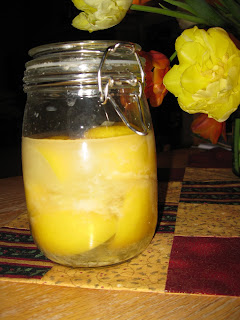
In Arabic, preserved lemons are حامض مرقد (hamad m'rakad). It literally translates to "sleeping lemons." Preserved lemons can be all sorts of fancy, but mine are just Meyer lemons, a bit of extra juice, and sea salt (A LOT of sea salt.) To use them, fish out a quarter, half, or whole lemon, scrape away the pulp and the white part of the rind, and use only what's left of the yellow part of the rind. Most recipes call for it to be thinly sliced in long strips. You can also use the pulp if you'd like to kick things up a notch or two, but generally it's just the rind.
Preserved lemon goes well with chicken or lamb dishes, in salads, vinagrettes... it's a strong salty/sour mix, kind of like capers. So anything that you think that would go well with.
Here are some great recipes to try out:
I made this for Christmas Eve dinner and it was a hit! Made it again with dad's family for our winter gathering and it went over well!
http://rosas-yummy-yums.blogspot.com/2008/05/lemony-beef-and-new-potato-tajine.html
Lamb with preserved lemon and lots of spices:
http://www.janespice.com/recipes/slow-braised-lamb-with-preserved-lemon-cumin-coriander-and-turmeric
Super excited to try this one- Moroccan style gazpacho!
http://www.tigersandstrawberries.com/2008/07/08/moroccan-gazpacho/
So that's the lemons. And what about the birds? It's just one, specifically. I just purchased Andrew Bird's new album, Noble Beast. I could probably have moved to Morocco without it in my life, but I probably would have felt like a lot was missing. Now I have it and my life is that much richer for it.
If you did not receive a jar of lemons, but you are interested in making some of your own (it's so easy!) check this out: http://www.foodgal.com/2009/01/meyer-lemons-the-salty/

In Arabic, preserved lemons are حامض مرقد (hamad m'rakad). It literally translates to "sleeping lemons." Preserved lemons can be all sorts of fancy, but mine are just Meyer lemons, a bit of extra juice, and sea salt (A LOT of sea salt.) To use them, fish out a quarter, half, or whole lemon, scrape away the pulp and the white part of the rind, and use only what's left of the yellow part of the rind. Most recipes call for it to be thinly sliced in long strips. You can also use the pulp if you'd like to kick things up a notch or two, but generally it's just the rind.
Preserved lemon goes well with chicken or lamb dishes, in salads, vinagrettes... it's a strong salty/sour mix, kind of like capers. So anything that you think that would go well with.
Here are some great recipes to try out:
I made this for Christmas Eve dinner and it was a hit! Made it again with dad's family for our winter gathering and it went over well!
http://rosas-yummy-yums.blogspot.com/2008/05/lemony-beef-and-new-potato-tajine.html
Lamb with preserved lemon and lots of spices:
http://www.janespice.com/recipes/slow-braised-lamb-with-preserved-lemon-cumin-coriander-and-turmeric
Super excited to try this one- Moroccan style gazpacho!
http://www.tigersandstrawberries.com/2008/07/08/moroccan-gazpacho/
So that's the lemons. And what about the birds? It's just one, specifically. I just purchased Andrew Bird's new album, Noble Beast. I could probably have moved to Morocco without it in my life, but I probably would have felt like a lot was missing. Now I have it and my life is that much richer for it.
Subscribe to:
Posts (Atom)